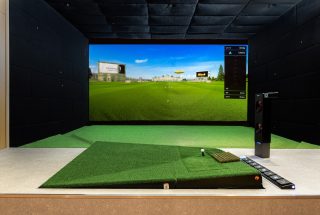
A simulator space from The Indoor Golf Shop can help you get more
out of your practice and accelerate your improvement.
Practicing is great, but practicing with purpose, direction and efficiency is even better. That’s where having a golf simulator – or access to one – can make a dramatic difference in getting better at golf.
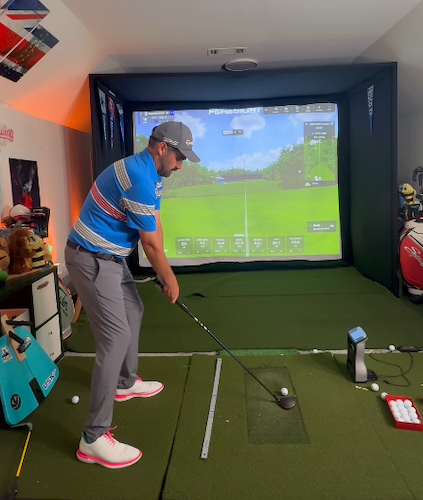
A simulator can make your practice time much more efficient. You can work on your swing and even play nine holes in about an hour. You can’t do that at the golf course, not in an hour, says Steve Buzza, the acclaimed coach, and Director of Instruction at Brook Hollow Country Club in Dallas.
Buzza is a big believer in the power of a home simulator. He has his own SIG10 Golf Simulator setup, courtesy of The Indoor Golf Shop.
Based in Dallas, The Indoor Golf Shop offers an industry-leading selection of residential and commercial indoor golf equipment, including a full selection of launch monitors and simulators from companies like Trackman,Uneekor, Garmin, Bushnell, Flightscope, ProTee, Full Swing, and Tru Golf, just to name a few.
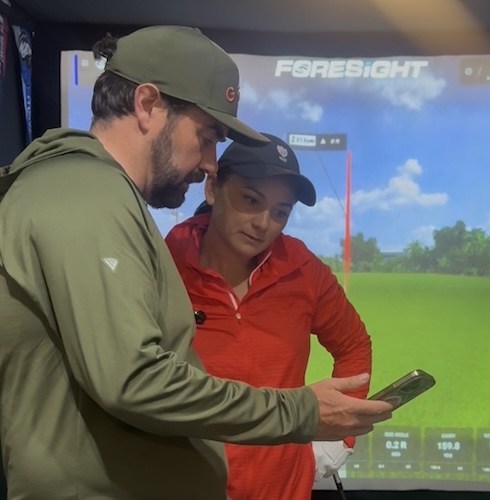
If you have your own simulator – or access to a simulator facility – you can practice and play without being limited by golf course hours.
But perhaps even more important are the numbers a simulator can provide, Buzza says.
For example, most players don’t really know how far they hit each club. Getting those real numbers can help when you play the course because, outside of other factors such as wind and temperature, you get a true picture of your real distances.
But one of the most important things a simulator can do is identify your tendencies.
Buzza is a big believer in a concept called “Bias in Your Favor.” The idea is that everyone has a pattern in their swing that they can probably use to their advantage once they identify it. The problem is that most golfers, especially higher handicappers, don’t know their patterns.
“The simulator environment gives us a chance to take multiple swings and get a good representation of what a golfer does,” says Buzza, who is originally from Southwest England and is a member of both the PGA of America and PGA of Great Britain and Ireland. “One of the issues with golf is that golfers get pretty sporadic because they don’t know the difference between a good shot and a bad shot. What tends to happen is that the path stays much more stable than people give themselves credit for.”
Buzza says that in 10 swings, you can get a surprisingly good idea of a moderately skilled golfer’s path to the ball. If a player hits a natural fade with a slightly out-to-in path, instead of trying to change that natural path, the player can learn to play to it. The same holds true for a player who is in-to-out and naturally draws the ball.
“So then you can have the discussion about where the face of the club needs to be,” Buzza says. “So if the bias in your favor is the fade, but you think it’s the draw, you’re playing against your bias. You’re going to struggle to score,” Buzza says.
On the course, a golfer might hit a push, a fade, a straight shot, and a hook and conclude, “My swing is all over the place.”
But 10 to 15 swings on a launch monitor can reveal that the club path is actually remarkably consistent, while the face is moving around.
More importantly, once a golfer identifies the pattern, a simulator can help hone in on a practice plan that will pay off on the golf course.
“So we start playing around with the start line. With a simulator, it’s awesome to have all this technology, but you can simply look at the screen and say, ‘If I have a path that goes slightly out to the right, my ball needs to hit the screen a little out to the right.’ We can keep it as simple as that. I then start focusing on where I hit the screen. I’m working on my start line,” Buzza says.
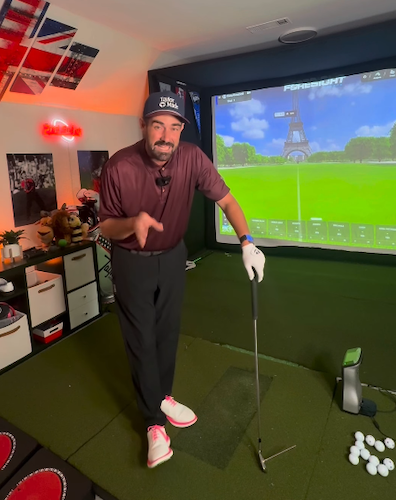 That, in turn, becomes a simple goal for building consistency.
Of course, the argument is that a simulator isn’t the golf course. But Buzza would argue that you can take that same visualization with you when you play.
“Sometimes the golf course doesn’t feel safe because it feels so big. But if you go out and set up behind the ball and pretend the screen is in front of you, it might not seem that way,” he says. “If you try to hit through that zone, you’ve got the best chance to utilize the skills that you have.”
The bottom line?
“Let’s just try to be good at being good at what you do,” he says.