

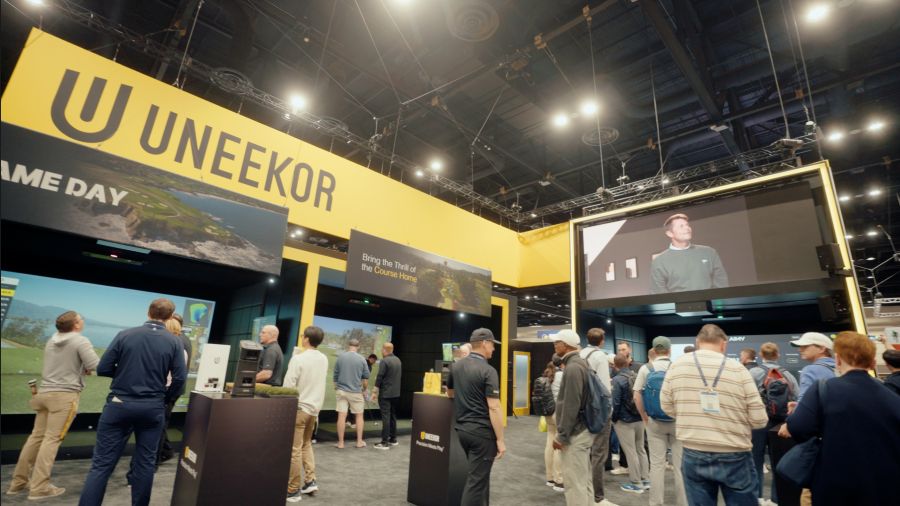
Whether it’s better hardware and software or AI technology, the one thing that was evident at the recent PGA Merchandise Show in Orlando is that launch monitors and home simulators continue to improve. And there’s a lot of healthy competition in the industry.
The last part, of course, is great for consumers as better sims and launch monitors are becoming even more affordable. They have more features than ever, and soon, they might even be able to coach you.
But as our expert, Jon Sherman, points out, there are still some limitations, so don’t ditch your instructor quite yet. Overall, though, it’s never been better to be a golfer, whether it’s working on your game on a simulator or the range, or simply enjoying virtual golf, even in the offseason.
“It’s not exactly like the TV market. But you’re getting better TVs for less money than you did 15 or 20 years ago,” says Sherman, who is the founder of Practical Golf, whose newsletters, website, and podcasts are all about helping golfers get better and how technology can aid in that pursuit. “I don’t know if it will be that extreme, but that’s generally what’s happening. Like the hardware is getting better, and it’s not costing as much.”
Sherman is also an affiliate for the Celina, Texas-based Indoor Golf Shop, which offers an industry-leading selection of residential and commercial indoor golf equipment, which includes a full selection of launch monitors and simulators from companies like Trackman, Uneekor, Garmin, Bushnell, Flightscope, ProTee, Full Swing, and Tru Golf. The company also offers projectors, wall padding, golf mats, and many other products to help you set up your own sim at home.
Sherman says that the 2026 PGA Show featured companies that are not only offering new artificial intelligence applications, but hardware and software that allow some simulators to provide data with clubhead or ball data without stickers. “We’ll see how accurate that is, but that could be interesting.”
The bottom line is that golfers want to know how much it costs to get an accurate launch monitor that also provides good simulation. “I think that answer will keep changing over the next three to five years,” he says.
When asked what innovations impressed him at the PGA Show, Sherman listed a few, starting with a product called Drop Tee. It’s a modular piece of turf that can be easily integrated into most mats. It detects a ball and can be set to tee up a ball from a half inch to two inches. “It’s a cool little problem solver,” Sherman said.
Another product that caught his attention was the new offering from Square Golf, which has an excellent launch monitor for well under $1,000. The new launch monitor, Square Omni, which has a screen, could come in around $1,600, he says, but offers plenty of accuracy and realism. There is no subscription, and it can even measure putting. “I think at that price point, it could potentially be another disruptor for people who want to build a home simulator on a budget. And it works outdoors as well, which the prior model did not,” he says.
And Rapsodo, which has seen so much success with its $700 MLM2Pro, is now offering a value-priced overhead unit that Sherman says could also be a disruptor in that space.
But when it comes to improving your game using sims and launch monitors, the big question revolves around using artificial intelligence. In other words, can launch monitors use AI to coach you to a better game? Sherman just did a podcast on this very topic, and he says he’s on the fence right now.
“I love technology. I use it myself, but I also don’t want it to confuse people and overwhelm them and put them on a wild goose chase,” he says. “Do I think that right now that AI is capable of giving you really good swing advice? Possibly not, because the golf swing is so nuanced.”
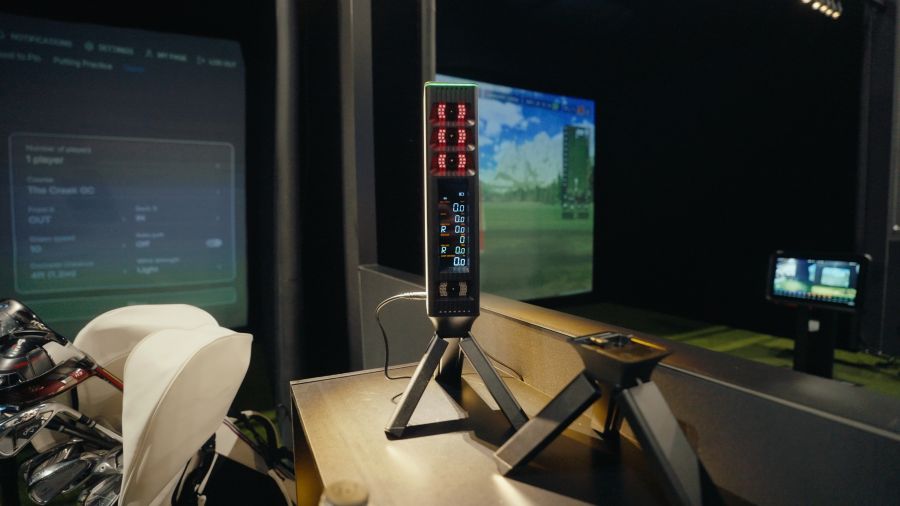
One AI product that received a lot of buzz at the Show was AIMY from Uneekor. It’s a prototype that is scheduled for release later this year. Using at least two cameras, it analyzes various aspects of a golfer’s swing, then identifies flaws and offers corrections.
“Now you’re integrating ball data, club data, and 3-D data all together,” says Sherman, who thought the concept was very cool and interesting. “Eventually that could be a killer feature.”
But when, if ever, will it be able to replace good human coaches?
“Based on my usage of AI – and I’m a heavy user of Chat GPT – it confidently makes mistakes,” Sherman says. “The golf swing is incredibly complicated. If you ask 15 different instructors how they would fix somebody’s golf swing, they might give you 15 different answers. How does AI decide that? Whose model of the swing are they using? Does it have the judgment a seasoned golf coach has?”
Sherman says one of the most valuable skills great instructors or coaches have is their ability to communicate. That might mean what they tell their students and what they won’t tell them based on their ability to learn and process.
For example, a player might have several swing flaws, but good instructors, drawing from their experience, might realize that correcting the right swing flaw or saying the right thing could correct the other deficiencies, too.
“It requires a lot of judgment that I’m not sure AI has yet,” he says. “I’m just not ready to declare that this is the answer to golfers’ problems, using an AI chatbot. I think it’s very interesting, though.”
Finally, another company that’s been gaining momentum as of late is GolfIn, which has been a bit under the radar. Its latest offering, the IDRA Pro, garnered a lot of buzz at the show. The new launch monitor boasts extensive spin and club data without using stickers.
“It looks like they’re trying to go into the professional territory, getting all the data that a club fitter or instructor would want at a little bit lower price level than Foresight or Trackman. I think it’s potentially a matter of brand recognition.” Sherman says.
Again, in the end, golfers and pros benefit from increased competition among companies that build and develop these units.
“Consumers have a difficult choice to make,” Sherman says. “I think a lot of decisions end up boiling down to not just price but the software that comes with that product. So it’s not necessarily just a hardware decision.”