
Teaching power couple Steve Buzza and Megan Padua Buzza know the game inside and out.
On a summer night in Dallas, after a sun-drenched day spent on the lesson tee at famed Brook Hollow Golf Club, English-born Steve Buzza climbs the stairs above his garage and powers on the golf simulator he shares with his wife, Megan Padua Buzza, herself a respected Top 50 LPGA teaching professional who, by day, conducts most of her instruction at 2nd Swing Dallas in The Colony, TX.
The room wasn’t originally built for golf. When Steve and Megan first toured the house, it was filled with storage boxes and forgotten household clutter. Most buyers would have seen an awkward bonus room. The Buzzas saw ceiling height. They saw enough width to swing a driver. They saw possibility.
Today a Foresight GC Quad launch monitor sits next to the hitting area, a projection screen fills the far wall, and while Megan gets the kids settled for the evening, Steve, one of Golf Digest‘s Best Young Teachers in America sneaks in nine holes at ten o’clock at night, just to help keep his game sharp.
Like it has for many leading instructors, indoor golf plays an integral role in the teaching approach for two of the game’s top young teachers. Steve is a biomechanics expert and takes a holistic approach to game improvement. “My expertise isn’t golf swings — it’s human movement. Before I recommend a swing change, I want to understand how your body naturally wants to move. When you build a golf swing around the athlete instead of forcing the athlete into a model, improvement becomes more sustainable and far more enjoyable,” he explains. “My job isn’t to make everyone swing the same way. My job is to find the movement solution that fits the individual, the most efficient swing your body can repeatedly produce.”
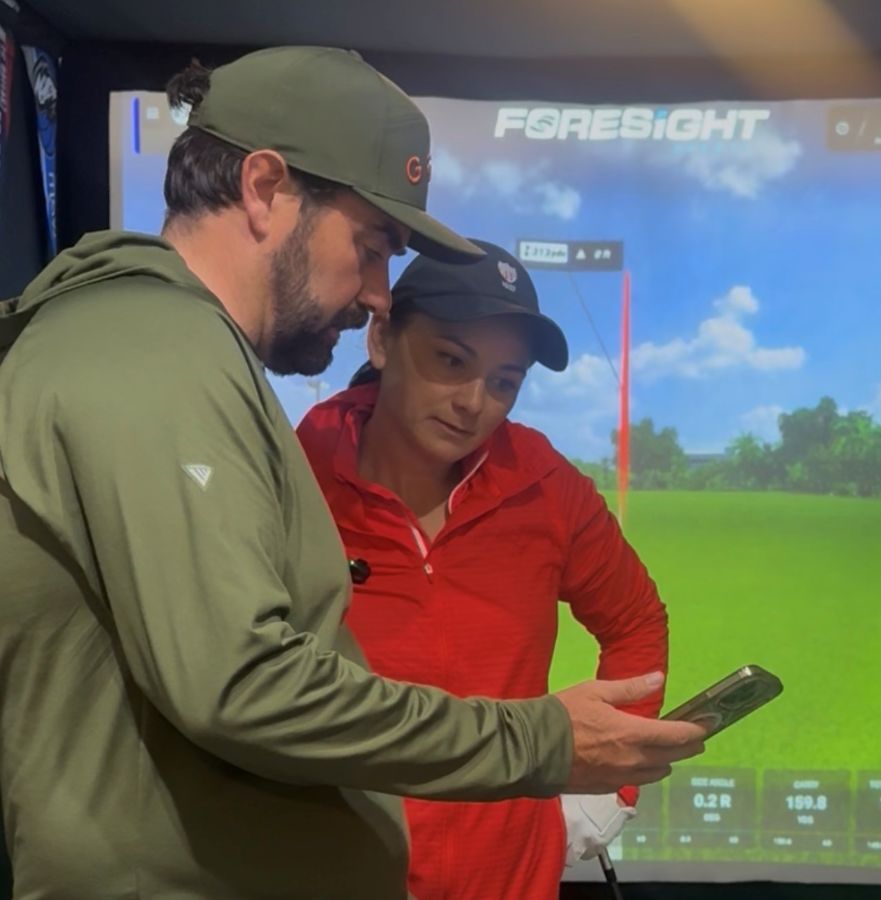
Technology and reliable instant feedback play a key role in helping Buzza formulate a working plan for each of his students. Often, that leads to tracking key shot metrics with a launch monitor.
“Indoor coaching gives us something that’s very difficult to find in golf: control. When you remove wind, uneven lies and environmental distractions, you can finally understand what’s actually causing the golf ball to behave the way it does,” he says. “There’s a reason scientific research is conducted in a laboratory. If you’re trying to understand cause and effect, you have to control variables. The simulator is one of the best diagnostic environments in golf. It allows me to isolate movement, collect reliable data and help players improve faster.”
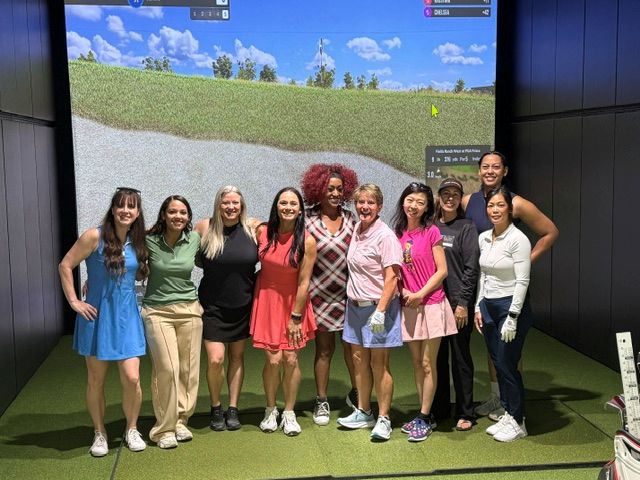
Megan also prefers taking the indoor route – especially in Texas, where the weather can be notoriously dicey.
“I’m a huge fan of simulators because they give us a chance to get more reps in, regardless of the severe weather out here,” she says. “There’s really never a situation where we have to cancel a lesson. It always surprises me how many students don’t even know their carry distances or how far they hit the ball in general. Sims bring major awareness when players can actually see the numbers, and they’re completely mind-blown when they start learning more about their swing mechanics.”
To keep things fresh, Padua Buzza frequently activates different games and training tools on the sims. She notes that this approach helps golfers shift their perspective, as they can sometimes get overly focused on the ball rather than the target.
“I also love taking students on the course, which is one of the biggest requests I get,” she says. “But if you go to local public courses, you often won’t get very many holes in. I’ve tried it. Playing on the sims works so well because it allows me to give an on-course playing lesson and a technical lesson at the same time. It’s just an incredible tool.”
Steve also appreciates the versatility of taking lessons from the sim environment to the golf course. “The beauty of a simulator is that you can spend forty-five minutes building a skill and then immediately test that skill in a playing environment. That’s an incredibly efficient way to learn,” he says. “The simulator is the workshop and the golf course is the proving ground. You need both.”
And there’s a methodology behind incorporating indoor learning into his lessons, especially with beginners. “One of the biggest barriers to golf isn’t ability — it’s surviving the early learning phase. Simulators give beginners a place to build confidence before they have to deal with the pressures of the golf course. Indoor environments help shorten that excruciating learning curve. For a beginner, learning in a simulator removes many of the social pressures that can make golf intimidating.” Buzza says.
Technology-wise, Padua Buzza has plenty of indoor toys at her disposal. At 2nd Swing, she utilizes Trackman, PuttView, and Quintic. At home, where she also offers private lessons, she uses the couple’s Foresight GCQuad system. Other locations where Megan instructs feature Full Swing Golf sims and TruGolf’s E6 Connect software.
Perhaps due to this breadth of options, she finds teaching indoors to be more effective in certain scenarios than being out on the range. “I’m such a big believer in indoor instruction because people get even more out of the experience,” Padua Buzza says. “With these tools, I’m able to really connect with people and get results faster. That’s why a lot of my students constantly post about our sessions and offer online referrals, which is really rewarding.”
Her biggest challenge teaching on sims in Texas? The virtual world doesn’t always perfectly replicate the massive amount of rollout that flat, hard Texas fairways provide. “I always emphasize to students that they need to learn their carry distances,” Padua Buzza says, “because we get a ton of roll out here—unless it rains heavily.”
Back in the Buzzas’ above-the-garage golfing paradise, Steve is dialing in swings before bed and the wonder of the technology and ultimate convenience of owning this space is not lost on him.
“As a coach, a husband and a father, I don’t always have four hours to play golf. A simulator lets me play eighteen holes in forty-five minutes at ten o’clock at night. That’s not a substitute for golf — it’s access to golf,” he explains. “The question isn’t whether a simulator perfectly replicates the golf course. The question is whether it creates opportunities to practice, learn and play that otherwise wouldn’t exist.”