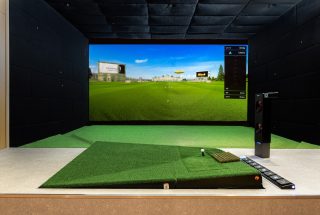


Indoor golf has undergone a massive transformation over the years, shifting from a glorified pixelated arcade pastime into a high-fidelity training environment. According to indoor golf expert Jon Sherman, Founder of Practical Golf and Author of The Four Foundations of Golf, the video game feel of early simulators has been replaced by immersive technology that mirrors the physics and aesthetics of a real outdoor course. One of the most significant advancements has been the elimination of the 6-second shot latency after you swing. “That delay after you hit your shot is almost non-existent now,” says Sherman. “So you’re getting a real-time visual reaction to the shot as you would on the course – combined with better processing speeds and graphics.”
Today’s top-tier launch monitors from Trackman, Foresight and Uneekor provide nearly instant feedback: The moment a ball hits the screen, the virtual ball is already seamlessly in flight, which is essential for a realistic feel.
The visual experience has also been upgraded through 4K graphics that offer crisp textures for grass, sand and water. Achieving this level of realism requires a triple threat of hardware: a high-lumen 4K projector, a premium impact screen, and a powerful gaming computer to handle the rendering. Some high-end installations now even use curved screens to wrap the environment around the golfer’s peripheral vision, making the experience feel less like looking at a screen and more like immersively standing on an actual tee box.
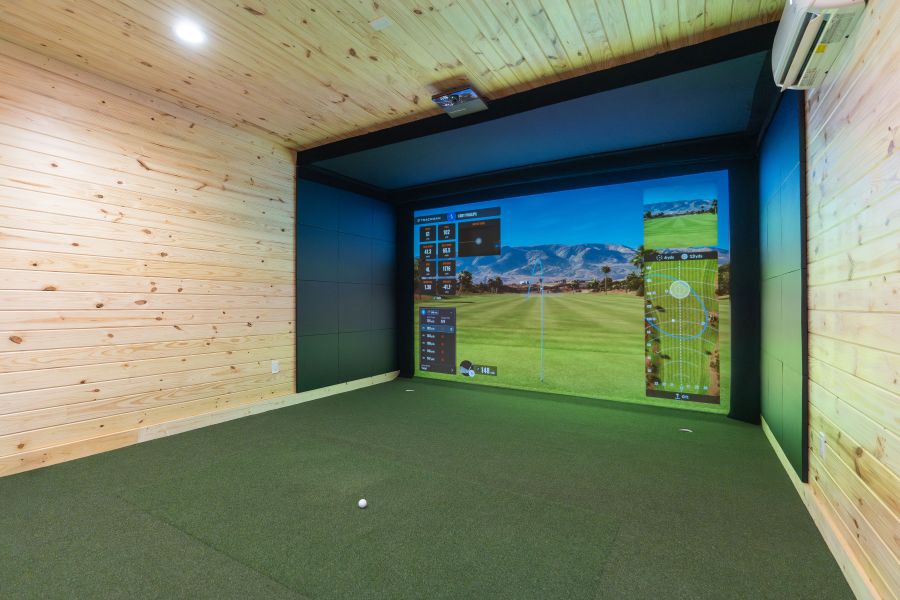
Realism extends beyond aesthetics into the accuracy of ball behavior, too, which Sherman highlights as a key for game improvement. “You can run good tests on your tee shot dispersion, to figure out and better understand what are typical misses,” he says. “If I hit 30 drivers, what does it look like left to right in terms of how far that dispersion is? A lot of the software can show you that visually now.” Golf simulators also allow for mastering wedge benchmarking for specific yardages, which is often difficult to do on a traditional driving range because range balls are commonly poor or are limited-flight models. Sherman notes that you can genuinely create any virtual scenario you would see out on the golf course or range, such as hitting a 50-yard wedge shot over a bunker. Knowing and practicing exact iron carry numbers removes the guesswork when facing hazards once you hit a real course. “That feedback on the sim is very helpful for exact distances,” he says. “If you’re looking for precision, it’s hard to get that with range balls.”
The physical sensation underfoot is another area of innovation. While cheap mats can be too forgiving by allowing a club to bounce into the ball, expert-recommended surfaces provide honest feedback on heavy shots and protect the golfer’s joints. “The Fiberbilt goes the bristle route, which I’ve used at times to protect my elbows,” says Sherman. “The upside of that type of mat is that first you get less wear-and-tear on your joints. And also you get better feedback on heavy shots. It’s easier to dig into that mat. If you’re using a cheap range mat, you’re not getting that feedback. It’ll bounce off the mat and you’ll still hit a good shot, whereas on the course, that same shot would be chunked. Personally, I would choose The Indoor Golf Shop’s SIGPRO that has a firmer surface but there’s give to it. You can still dig under some firmness to it, like real turf, and get some of that feedback if you catch it heavy. And there’s still some joint relief built into it because it absorbs impact.” The next frontier involves hydraulic platforms that can tilt the floor to simulate uphill, downhill or sidehill lies, aiming to solve the final limitation of perfectly flat indoor surfaces.
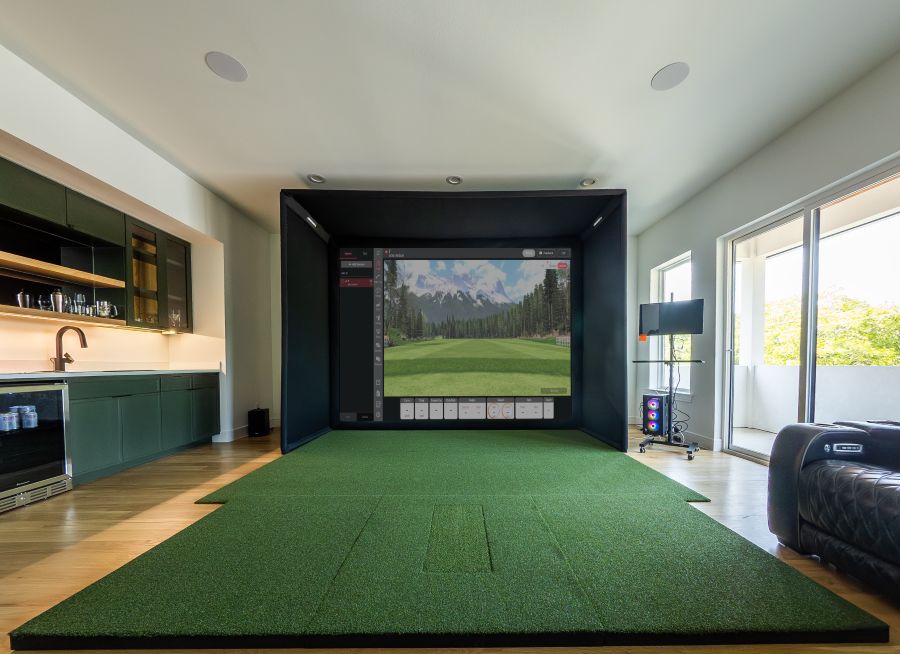
What’s the most realistic experience you can have right now? Sherman points to Trackman as the gold standard for the overall experience, for anyone wanting the best software, graphics, user interface and challenge. He also likes GSPro for its 4K graphics and avid community of golf course creators, as well as Uneekor’s latest systems. “Who knows,” says Sherman. “Maybe someone will push 4K graphics to 8K or to a more OLED-type of resolution down the road – where you get ultra sharp, crisp displays that are mind blowing.” As realistic as today’s sim experiences are, you may soon look back on it as video game-like.